EV Charging Cost Calculator
Find out exactly what it costs to drive your EV — per mile, per kilometre, or per journey.
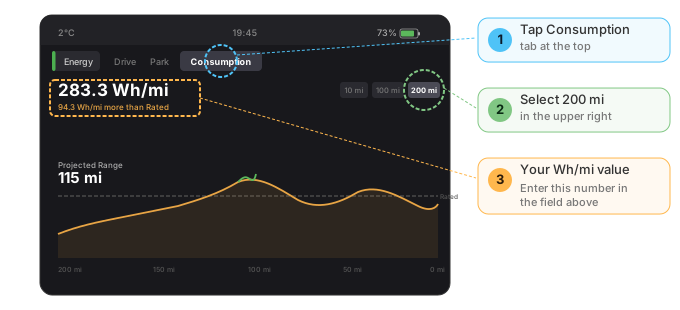
Check your EV's energy or efficiency display to find your average consumption figure.
Enter pence, not £ — e.g. 24 for £0.24/kWh
Enter your consumption and electricity price to see your cost.
The cost to run an EV per mile (or kilometre) depends on two things: how efficiently the car is driven, and the price you pay for electricity. Typical EV energy consumption ranges from around 240 Wh/mile for efficient models to over 400 Wh/mile for larger, performance-focused EVs.
Home charging is almost always the cheapest option — in the UK, a standard tariff costs roughly 24–30p/kWh, putting the cost per mile around 6–9p. Public DC fast charging typically costs 30–50p/kWh in the UK, or 25–45¢ in the US.
To get an accurate consumption figure, check the energy or efficiency display on your EV's dashboard and read the average consumption over the last 30 miles or 50 km — this reflects your real-world driving rather than manufacturer rated figures.
How to work out your EV's true cost per mile
The maths is simple once you have the two numbers that matter: your electricity price per kWh, and your car's efficiency in miles (or km) per kWh. Divide the price by the efficiency and you get cost per mile. A Tesla Model 3 averaging 3.5mi/kWh on a 26p/kWh UK home tariff costs about 7.4p a mile; a larger SUV like a Kia EV9 averaging 2.6mi/kWh on the same tariff costs closer to 10p a mile. In the US, a car doing 3.5mi/kWh on a 16¢/kWh average rate costs around 4.6¢ a mile — roughly a third of the per-mile fuel cost of an equivalent petrol SUV. Efficiency swings with speed, weather and load just as much as price varies by tariff, which is why the calculator above asks for your actual consumption rather than the factory-rated figure.
Home charging vs public charging costs
Where you charge matters as much as what you drive. In the UK, home electricity averages 24–28p/kWh (or as little as 7–9p/kWh on an overnight EV tariff), while public AC chargers typically charge 45–60p/kWh and public DC rapids 60–85p/kWh. In the US, home rates average roughly 15–17¢/kWh against 30–48¢/kWh at rapid networks like Electrify America or EVgo, though membership plans can bring that down. For a Hyundai Kona Electric or a VW ID.3 doing most of its charging at home, that difference alone is often the biggest single lever on total running costs — bigger than the make or model itself.
Public rapid charging still makes sense for road trips and top-ups — see the charge calculator for how long those sessions actually take.
Timing your charging to your tariff
Most home energy suppliers now offer an EV or off-peak tariff with a cheap overnight window, usually somewhere between midnight and 6–7am. Charging in that window instead of during the day can cut your per-mile electricity cost by 60–70% without changing anything about how you drive. Nearly every EV and home charger supports scheduled charging, so you plug in when convenient and the car (or charger) waits for the cheap-rate window to actually start drawing power — no need to set an alarm to unplug at a specific time.